

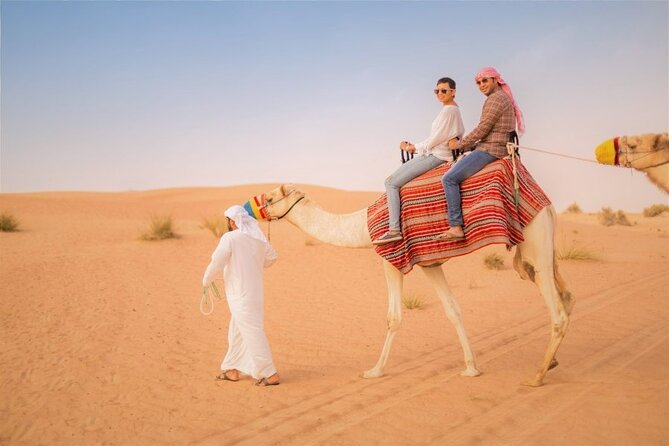
The camel ride is the part of a desert safari that most first time visitors picture before they book. They imagine a long trek across the dunes, the way camels are shown in old travel photos. The real ride on a desert safari in Abu Dhabi is much shorter than that, and it is better to know this before the day, so the short ride feels like a proper part of the trip instead of a disappointment.
On the safaris listed on this site, the camel ride is a short ride at the camp, included in the price of the safari. You are helped up, the camel walks a short loop with a handler beside it, and you are helped down again. It lasts a few minutes, it is calm, and it is the easiest way to get a photo with a camel and the dunes behind you. This guide explains how the ride works, where it happens in the day, who can ride, and what the longer ride option means.
What the short ride really is
The short camel ride happens at the desert camp, not out on the open dunes. After the dune drive and the sunset or sunrise stop, the group reaches the camp, where the camels are waiting near the seating area. A handler brings a camel to you, helps you climb on, and walks beside the camel for the whole ride.
The camel is seated when you climb on, so the step up is low. Once you are seated, the camel stands up, first the back legs and then the front, so hold the saddle and lean back slightly as it rises. The walk itself is slow and steady. The camel walks a short loop around the camp area, turns, and comes back to the same spot. The handler stays with the camel the whole time, and helps you down at the end. The camel sits down again before you step off, so wait for the handler to tell you it is time to get down.
That is the whole ride. It is not a trek, and it is not a race. The point of it is the experience of sitting on a camel, the slow rocking walk, and the photo. Most people in a group try it once, and that is enough. If you want a longer ride, that is a separate option, and it is covered below.
Where it fits in your safari
The short camel ride is included in the standard safaris, so there is no separate ticket to buy for it on this site. On the Evening safari, from AED 150 per person, the ride sits alongside dune bashing, the sunset stop, sandboarding, and the camp visit with gahwa and dates and a BBQ dinner. Pickup is usually between 3:00 and 3:30 PM, and the return is around 9:30 PM. On the Morning safari, from AED 250 per person, the ride sits alongside dune bashing and sandboarding, with pickup usually between 7:00 and 7:30 AM and a return around 11:30 AM. There is no BBQ dinner on the Morning safari, because the trip ends before lunch.
It is also included if you add a quad bike to either safari. The Evening safari with a quad bike is from AED 249 per person, and the Morning safari with a quad bike is from AED 350 per person. On a Private safari, AED 700 per vehicle for up to 6 guests, or a Private Morning safari, AED 800 per vehicle for up to 6 guests, the same activities are there, with your own vehicle and your own pace.
The ride comes after the dune drive, when the group is at the camp and the pace has slowed down. That is why it feels relaxed. The rough part of the day is over, the sun is low or the morning is still cool, and there is time to walk around the camp, take photos, and try the ride without rushing. If you are on the Without Dune Bashing option, the rough drive is skipped and replaced by a smooth drive with photo stops, but the camel ride stays in the day, because the ride itself is gentle.
The longer ride option
If a short loop is not enough, a longer camel ride is available at extra cost. The longer ride is not part of the standard safari price, and the extra amount is confirmed when you book, because it depends on the day and the group. No separate price for the long ride is listed on this site, so do not take a figure from another operator’s page as the price here.
To arrange it, mention the longer ride when you book on WhatsApp at +971 52 774 6208, before the day of the safari, so the camp can plan for it. On the day itself, tell the driver as well, so nothing is missed. The longer ride is still a guided ride with a handler, not a ride on your own, and it still starts and ends at the camp.
One thing to be clear about: the camel ride is a ride at the camp, and that is all it is. It does not include a visit to any other place, and this guide does not describe one. If you see a longer animal visit listed somewhere else, it belongs to a different operator or a different kind of trip, not to the safaris listed here.
Who can ride
Most people in a safari group can try the short camel ride, including children, as long as they are happy to sit on a camel for a few minutes. Children below 3 travel free on the safaris, and guests aged 3 and above pay the full adult price, so a family with young children can still join the same trip. Younger children usually ride with a parent sitting close by, or with the handler walking right beside the camel, and that works well.
There is no rule that says everyone must ride. Nothing on the safari is compulsory, and the camel ride is no different. If sitting on a camel does not suit someone in your group, they can sit out, watch, and take photos, and still enjoy the rest of the day. The dunes, the sunset or sunrise, the sandboarding, and the camp are all still there for them. If anyone in your group has a medical condition, mention it when you book, so the driver knows in advance.
Older guests often ask whether the climb onto the camel is too much. The honest answer is that the camel is seated when you climb on, so the step up is low, and the handler helps you. If you would rather not ride at all, say so at the camp. There is no pressure to try it, and nobody keeps score.
Photos: how to get a good one
The camel ride is one of the best photo moments of the day, because the camel is close, the light is soft, and the dunes are behind you. A few simple things make the photos better.
First, let someone else take the photo while you ride. Trying to hold a phone and hold the saddle at the same time is awkward, and the photo comes out worse. Hand your phone to a family member or a friend in the group, and let them take the photo from the ground while you ride.
Second, the best time for photos is while the camel is walking, not while it is standing up or sitting down. The walk is slow and steady, so the person taking the photo has time to frame it. Ask them to take several photos in a row, so at least one catches you looking at the camera instead of looking down at the saddle.
Third, keep your phone in a pocket with a zip or a button when you are not using it, or hand it to someone who is watching. The camp ground is soft sand, and a phone dropped there is hard to find.
One practical note: the handler will often offer to take a photo for you. That is fine, and it is the easiest way to get a photo of the whole group with the camel. Just check the photo before you walk away, so you can ask for another one if it did not come out.
What to wear
The camel ride is a short, calm activity, so there is nothing special to wear for it. Wear comfortable clothes you do not mind getting dusty, and closed shoes that stay on your feet. Sand will get onto your clothes either way, so leave anything you want to keep clean in the vehicle.
Sun protection matters more than most people expect. The sun is strong in the open desert, even in the morning, so bring sunscreen and sunglasses, and a hat if you like one. A small bottle of water helps after the dune drive. You do not need any special equipment of your own for the ride. The camel, the saddle, and the handler are all provided.
A few things people get wrong
The first mistake is expecting a long trek. The included ride is a short loop at the camp, a few minutes long. Go in expecting a short ride and a good photo, and you will enjoy it. Go in expecting an hour in the saddle, and you will wonder why it ended so soon. If you want more time on a camel, ask about the longer ride when you book, before the day.
The second mistake is thinking it costs extra. On this site, the short camel ride is part of the safari you book, not a separate activity with its own price. Only the longer ride costs extra, and its amount is confirmed when you book. If you see a camel ride price somewhere else, it belongs to a different operator or a different kind of trip, not to the safaris listed here.
The third mistake is expecting the ride to include a visit somewhere else. It does not. The ride happens at the camp, with the camp camels, and that is all it is.
The fourth mistake is trying to ride without the handler. The handler is there for a reason, and the camel only walks with the handler beside it. Let the handler do the work, hold the saddle, and enjoy the ride.
How to book a safari with a camel ride
Booking is the same as for any safari on this site. Pick the package that fits your group, then book by the form on the package page or by WhatsApp at +971 52 774 6208. Tell us the package, the date, how many guests are travelling, and where you would like to be picked up. Children below 3 travel free, and guests aged 3 and above pay the full adult price. If you want the longer camel ride, mention it when you book, so it can be arranged in advance.
There is no upfront payment and no deposit. You pay on the day, in cash to the driver or by card at the camp, with a 10 percent extra charge on card payments at the camp. Cancellation is free, because we take no upfront payment, so there is nothing to deduct from and nothing to refund. If your plans change, message us on WhatsApp and let us know.
The camel ride is a small part of a desert safari, but it is the part many visitors photograph first. A short walk, a slow rocking pace, and the dunes behind you. That is what it really is, and that is all it needs to be.